The Gene Centered Framework of Evolution

Here is a strange question that reveals whether someone truly understands evolution. Why does waste smell foul to humans? Most assume it is due to bacteria or chemicals. The real answer is that our ancestors who thought it smelled good got sick and died before passing on their genes. For flies, the same scent is a nutritious meal. What smells foul or pleasant is not objective. It is entirely about survival and replication.
1. The Problem with Survival of the Fittest
Most people think natural selection is about the fittest individual organism surviving and passing on its genes. It makes intuitive sense. However, this fails to explain many phenomena in nature. Worker bees sting predators to protect the hive even though it kills them. Female worker ants are sterile and never reproduce. Monkeys adopt orphans. Wolves bring meat to non hunting pack members. Squirrels give alarm calls to warn others while putting themselves at extreme risk. Nature is full of altruism where creatures help others at their own expense. If evolution is all about selfish individuals, this should not happen.
2. Why Groups Do Not Work Either
Maybe it is about the survival of the species. That seems to make sense as individuals sacrifice themselves for the greater good of their group. But there is a flaw in this thinking. For natural selection to work, you need replication and a pruning process where some copies survive and others do not. Species do not make copies of themselves. Groups do not replicate as cohesive units. They fragment, merge, and change over time. You almost never get copies of groups fighting other copies of groups. So if it is not the individual and it is not the group, what is it?
3. The Birth of the First Replicator
Let us travel back to the early Earth. There is nothing interesting, just simple molecules floating around. Occasionally, these molecules get energy inputs from UV light or geothermal heat and interact. Most of the time, nothing happens. Sometimes, they combine into more complex compounds. Most combinations are unstable and fall apart quickly. But occasionally, by pure chance, a configuration forms that is more stable than the pieces it is made of. And then, one day, a molecule forms that happens to attract complementary pieces from its environment. Piece by piece, it assembles a copy of itself. Then that copy does the same thing. Replication has begun. This is the first replicator. It is not alive and has no intent or purpose. It is just a molecule that happens to make copies of itself due to its chemical properties.
4. Competition and the Shift to Genes
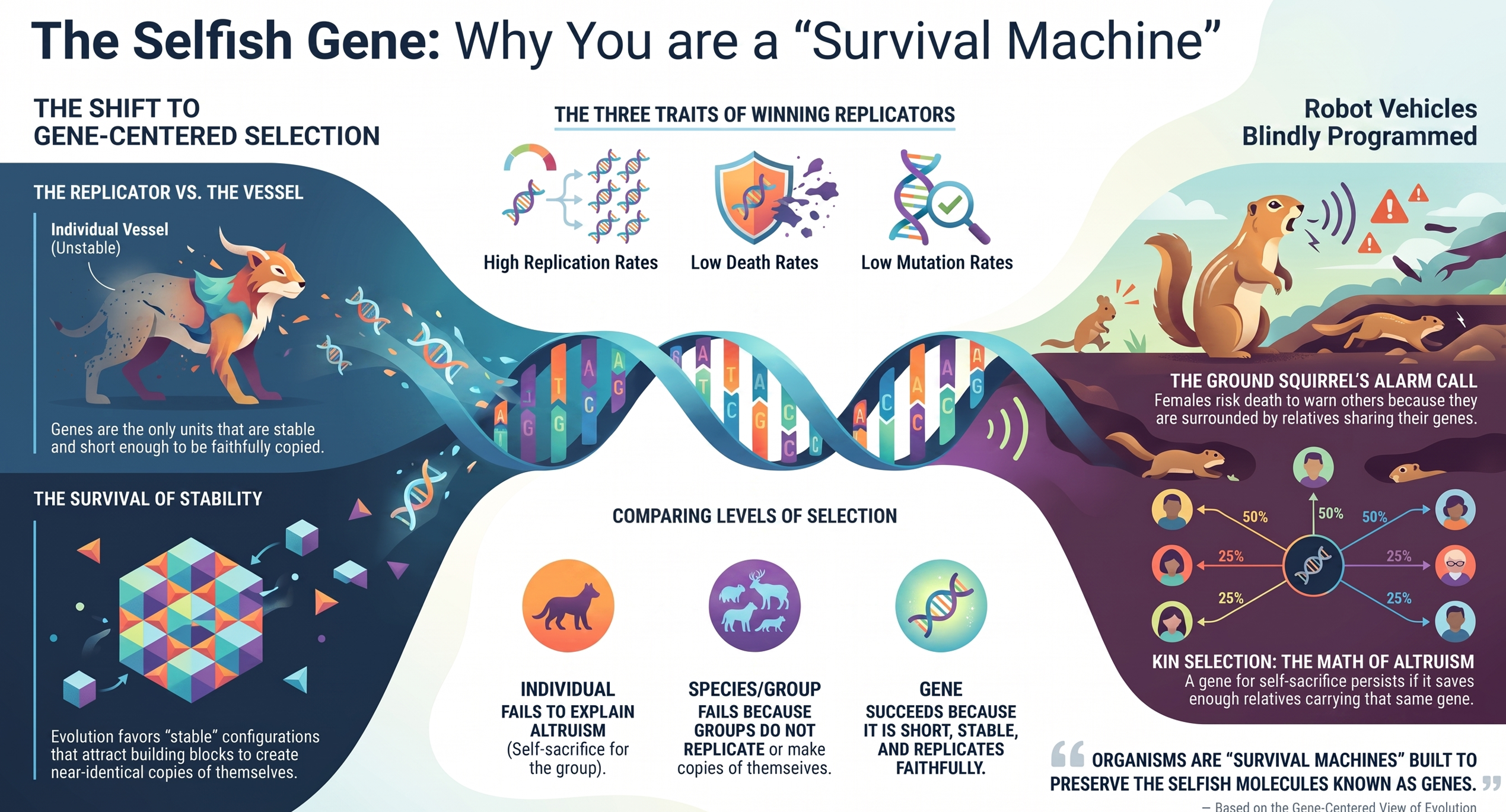
Once the replicator appears, it multiplies until it fills the environment. But during copying, mistakes happen. A stray UV ray hits the replicator, resulting in a slightly different shape. These mutations might be harmful, beneficial, or neutral. Now the environment becomes a battleground for limited resources. The replicators do not strategize. They simply react according to chemistry. Over billions of years, these replicators evolved increasingly complex strategies. They developed defenses, built scaffolding to increase survival chances, and found ways to move and store energy. This scaffolding became so effective that it is still around today. We call these survival machines bacteria, plants, fungi, and animals. Everything alive was built as a survival vessel for these replicators. Today, we call them genes.
5. Kin Selection and Altruism
This perspective explains altruistic behaviors perfectly. Consider California ground squirrels. Females give alarm calls when they spot a predator, putting their own survival at risk. Why? Because a squirrel shares half its genes with its children and siblings, and a quarter with its aunts and uncles. When a squirrel gives an alarm call, there is a very high chance the squirrels hearing it carry the exact same genes. If the warning call saves at least two copies of those genes in relatives, the sacrifice pays off from the perspective of the gene. It does not matter which individual helps the genes replicate. This principle is called kin selection. And it predicts exactly what we see in nature as male squirrels that do not live near relatives almost never give alarm calls.
6. Conclusion: The Baseline Truth
The gene centered framework provides the most precise understanding of evolution. Genes are the fundamental replicators whose differential success shapes biological diversity. Organisms function as vehicles constructed by genes to enhance their own persistence. Evolution arises from the interplay of replication, mutation, selection, and random genetic drift. While it may seem unsettling to think we are driven by molecules deep within our cells, we still perceive the world as individuals. The truth of how evolution works only adds a deeper layer of understanding to the beautiful complexity of the living world.